
The Undercroft Skate Space
How an 'empty' space became Britain's most famous skate spot

There are many different characteristics that shape how we experience places. Few are as important as age. Geographer Gill Valentine argues that, with the exception of a few specialised spaces such as playgrounds, public places in the UK have been naturalised as adult places. The interesting question, then, is where young people go once they outgrow the playgrounds. Where are the places for youths? Valentine suggests that youths are liminal – between places – and therefore without place.
‘everyone sees a city differently’
If young people are often made to feel excluded from and unwelcome in many public places, they have sometimes carved out places in which they can feel like insiders. Geographer Hugh Matthews identified ‘the street’ as the place that is for youth. ‘The street’ here is taken as a metaphor for all outdoor public spaces in which youths ‘live’.
The Undercroft of the Southbank Centre at Waterloo in central London is widely recognised as the birthplace of British skateboarding and has been home to boarders, riders and graffiti artists. It is celebrating its 50th anniversary this year.
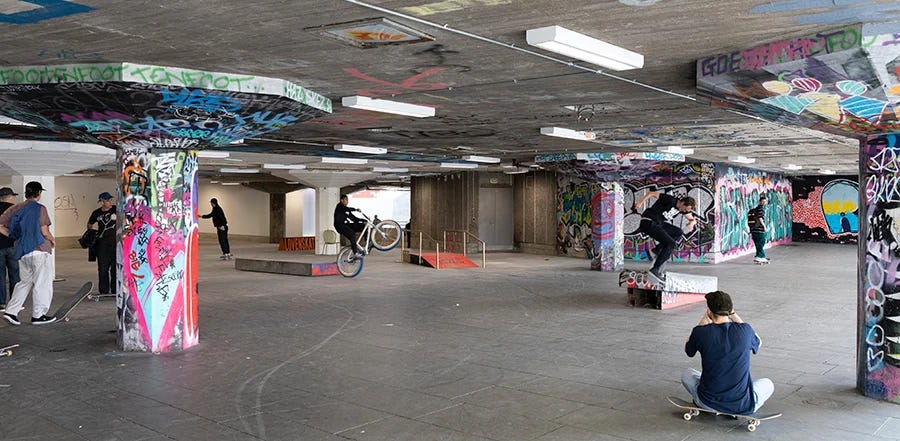
It was not a public space designed for skaters. It was an ‘empty space’ left over with no purpose when Queen Elizabeth Hall was built. As Andrew Tuck put it on The Urbanist podcast, ‘everyone sees a city differently’ and skaters are used to seeing ‘seemingly unremarkable pieces of urban infrastructure—benches, squares, railings and steps—as having the potential to become the site of their next trick’.
However, there has always been an uneasy relationship between this space for skaters and the formal institutions around it. In the early 1990s, bollards and pebbles were introduced to deter skaters. In 1993, the lights were switched off to stop filming and photography.
More drastically, in 2013, proposals to extend the Southbank Centre to create more space for restaurants and shops would have permanently closed the skate space. This was another example of the power of capital to reshape places. It was never stated as such but many users believed that part of the motivation was to remove this unwanted youth-controlled place and return it to its rightful status as an ‘adult place’.
In a statement of the importance of place, one skater said, ‘they’re taking a chunk of us…This is a mythic place’. While acknowledging plans to rebuild the skatepark elsewhere, he noted, ‘you cannot knock down and rebuild St Paul’s’ – places are not just the building materials they are made of.
The Undercroft is a particularly interesting example as it is the unusual case in which the power of youth was able to resist capital’s attempts to reshape place. Uniting under the Long Live Southbank (LLSB) group, the users of the Undercroft were able not only to resist plans to redevelop the skate park but even to have improvements made. This year the Undercroft has been granted Grade II listed status, adding a layer of legal protection against future attempts to alter the site.
LSSB coined the term ‘reclaration’ for this, a synthesis of reclamation and restoration.