
Regeneration, renewal, redevelopment, rebranding....
Why do geographers love so many different names?

To an A level geographer the subject can seem frustrating for its tendency to give several different names for the same, or near identical, things. Corrasion and abrasion. Cirques and corries and cwms. Nuée ardente and pyroclastic flow. The situation is particularly confusing in the case of the processes by which a formerly run down area can be improved as the terms all seem to start with 're-'. How meaningful really are the differences between urban renewal, regeneration, redevelopment, rebranding and reimaging?
The textbook will tell you that there is a difference.
Urban redevelopment is focussed on improving the physical infrastructure of a place.
Urban renewal for some is just a straight synonym for redevelopment. For others though 'renewal' suggests a greater focus on improving opportunities for people through education and job creation.
Re-branding and re-imaging are clearly different as they don’t imply significant financial investment in improving social or physical infrastructure. However, they are extremely similar to each other. Though, again, some suggest that re-imaging attempts simply to sell a positive image of a place, whereas re-branding also includes elements of replacing a previous negative image.
Finally, regeneration is suggested to be a holistic term encompassing all of the above approaches.
It is interesting to look at some data from the Google Ngram Viewer which presents the frequency with which these terms have been used in English language writing (in this case, British English between 1945 and 2022). I’ve used the ‘urban’ precursor to try to focus on the use of the term of interest here rather than the many other possible uses of the words renewal and regeneration in particular.
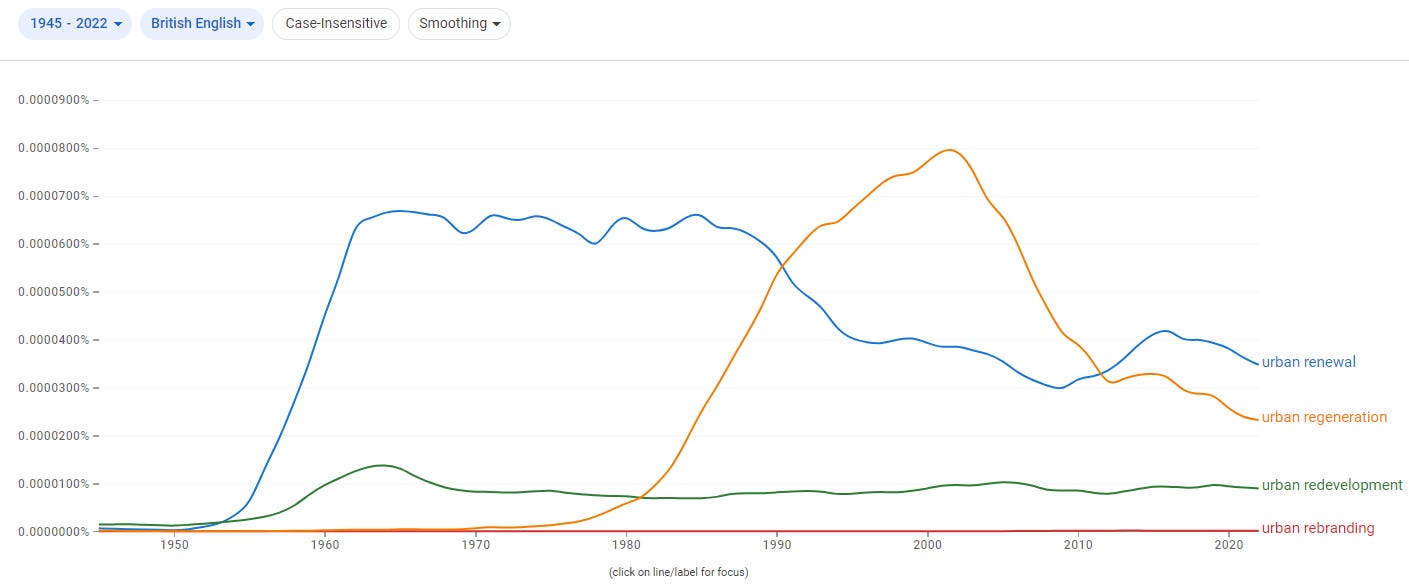
Writing about any of these ‘re-’ processes starts in earnest from the mid-1950s coinciding with the need to rebuild Europe’s cities after World War Two. The early frontrunner was ‘renewal’. This was almost certainly not in the sense offered by those textbooks that suggest ‘renewal’ is concerned primarily with improving social opportunities. Rather it was likely to be heavily focussed on rebuilding the infrastructure and housing.
Urban regeneration comes to prominence from the early 1980s and takes the lead from around 1990s. Ironically this coincides with the creation of Urban Development Corporations suggesting that, despite the name, perhaps their work was more often written about as regeneration rather than redevelopment.
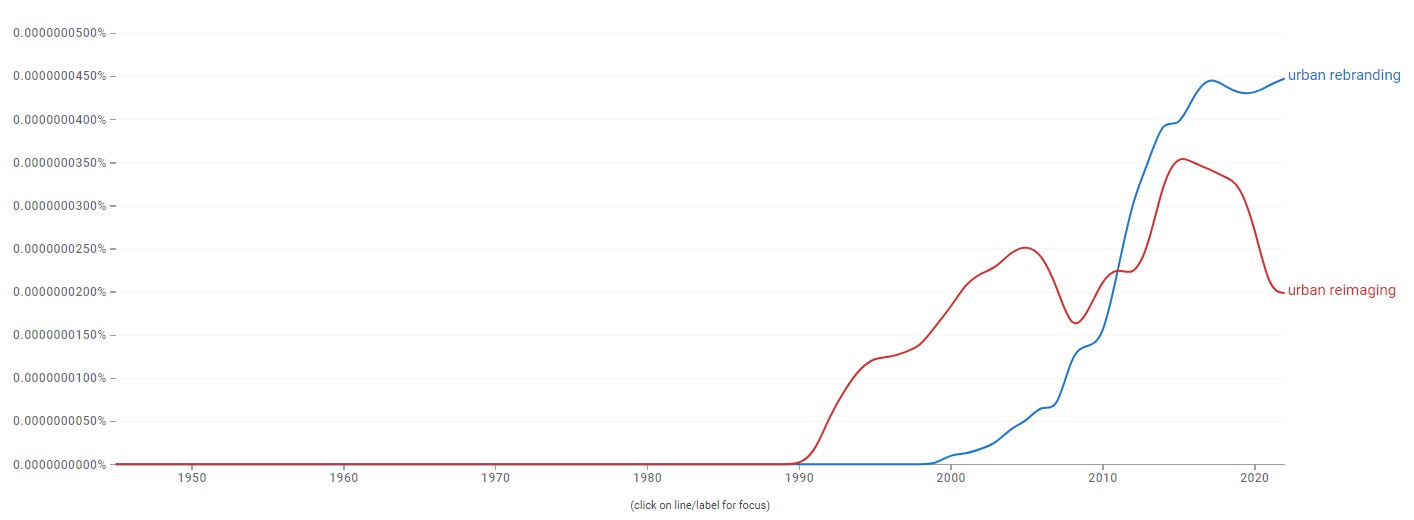
Of all these terms perhaps ‘rebranding’ and ‘reimaging’ are the hardest to distinguish from each other. Neither features significantly enough to register in Figure 1. However, looking at them alone it is clear they are relatively recent terms with ‘reimaging’ appearing first but being overtaken by ‘rebranding’ around 2010.
These changing usages beg important questions: Are they meaningfully different terms and their changes over time reflect changes in the way in which we have addressed run-down place over time? Or, are these terms largely synonymous and the changes reflect simply changing fashions as developers and governments want to show they are doing something new, different and exciting?