
Changing places in Changing Places
A novelist’s insight into attachment to place

I recently read Changing Places, a novel by David Lodge set in 1969 but written in 1975. It follows two academics – one British and one American – as they take part in an academic exchange programme. Its central idea is that places are different, and you can understand your home place better by experiencing others.
It isn’t a great book. It’s interesting and funny, but it is rather dated. For example, his fictional places are clearly modelled on Berkeley, California and Birmingham, UK. Yet, thanks to globalisation those two places are much more alike than they once were. The sense of culture shock, simply from crossing the Atlantic, no longer rings true.
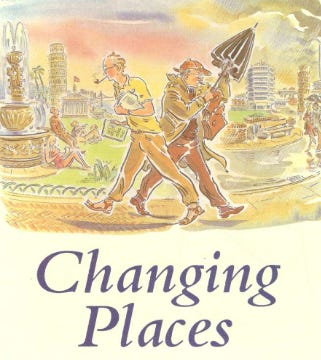
I enjoyed two passages in particular. The first develops the metaphor of an umbilical cord to describe how, even as we travel, we remain connected to our home places:
Imagine, if you will, that each of these two professors of English Literature (both, as it happens, aged forty) is connected to his native land, place of employment and domestic hearth by an infinitely elastic umbilical cord of emotions, attitudes and values – a cord which stretches and stretches almost to the point of invisibility, but never quite to breaking-point, as he hurtles through the air at 600 miles per hour.
It’s a striking way of capturing something that still feels true: mobility doesn’t sever our attachment to place. However far we travel, our connection to home places stretch with us rather than breaking.
The second passage reflects on the United States of America in 1969:
Though he has followed the recent history of the United States in the newspapers, though he is well aware, cognitively, that it has become more than ever a violent and melodramatic land, riven by deep divisions of race and ideology, traumatized by political assassinations, the campuses in revolt, the cities seizing up, the countryside poisoned and devastated – emotionally it is still for him a kind of Paradise, the place where he was once happy and free and may be so once again.
Changes in the places it describes have made the book feel dated, but not entirely. Some places have clearly changed – Birmingham is now too similar to Berkeley for the satire to really land. Others, uncomfortably, have not.
Funny. I always enjoy the historical aspect of novels, the fact that they show how the world used to be. So what you call "dated" is added value to me. Just as the characters in Changing Places learn about their own culture by living in a different one, we learn about our present by discovering the past. That said, maybe a different context than yours contributed to my response to the humour in the book. I read this novel while I was studying in Poland 20 years ago, and it made me laugh a lot. The administration of my university was very similar to the British one described in the novel, but the ministry of higher education of the time was trying to introduce elements of the American system and encountering a lot of resistance from the professors. So many headaches of the characters felt familiar. What I also remember is the cross-romance they have, which shows different attitudes to sex and different gender roles on both sides of the Atlantic. That was quite interesting too. There's also a game described in the book which I played with friends afterwards: the game when you name books you haven't read and you get a point for every person in the group who has read it. Very funny to play.